




 |
 |
 |
 |
 |
 |













IMPOSTOR PHENOMENON (IP)
Most people who experience the Impostor Phenomenon (IP) would not say,”I feel like an impostor.” Yet, when they read or hear about the experience, they say, “How did you know exactly how I feel?” And how do they feel? Even though they are often very successful by external standards, they feel their success has been due to some mysterious fluke or luck or great effort; they are afraid their achievements are due to “breaks” and not the result of their own ability and competence. They are also pretty certain that, unless they go to gargantuan efforts to do so, success can not be repeated. They are afraid that next time, I will blow it.
I experienced IP feelings in graduate school. I would take an important examination and be very afraid that I had failed. I remembered all I did not know rather than what I did. My friends began to be sick of my worrying, so I kept my doubts more to my self. I thought my fears were due to my educational background. When I began to teach at a prominent liberal arts college with an excellent academic reputation, I heard similar fears from students who had come for counseling. They had excellent standardized test scores grades and recommendations. One of them said, “I feel like an impostor here with all these really bright people.” In discussing these students, Dr. Suzanne Imes and I coined the term “Impostor Phenomenon” and wrote a paper on the concept.
I have also developed the Clance Impostor Phenomenon Scale (CIPS), which can help you see how you compare to others. There is good reliability and validity data on the test. Many of my students have contributed to IP research and the experience has been researched nationally and internationally (see the IP reference list). Over the years, the Impostor Phenomenon research and clinical information has become very well known and many coaches, executives, academics, counselors, and psychologists also find the IP concept helpful.
I work with clients to change their Impostor Phenomenon experience so they can affirm their competencies and successes. In addition, I do individual telephone consultations and am available to do presentations and workshops on the Impostor Phenomenon for businesses, organizations, and universities.
CLANCE IMPOSTOR PHENOMENON SCALE (CIPS)
Please feel free to take the IP test, for personal use only, and follow the instructions. It is advisable to do the test first and afterwards view the scoring instructions. Test results do not constitute an official diagnosis. However, if you have any concerns about your test results, you may browse the IP literature on this site or consider obtaining my IP book for more information or consult a local mental health provider for counseling. At this time, I do not respond to individuals’ email/correspondence pertaining to IP questions or test results; however, I can schedule an individual consultation via telephone for non-local persons. For local persons, I may be available for scheduling an appointment in person or telephone consultation.
For persons wanting to use the IP test for commercial, professional (e.g., publication, presentation, or website) or for research purposes, permission for use must be obtained through me. Please refer to the Disclaimer webpage for copyright restrictions.
CLANCE IMPOSTOR PHENOMENON SCALE (CIPS) SCORING
IMPOSTOR PHENOMENON WORKSHOPS/PRESENTATIONS
The following includes selected workshops/presentations I have done on the Impostor Phenomenon throughout my career. Please email for a comprehensive vitae. I am also available to do presentations and workshops on the Impostor Phenomenon for businesses, organizations, and universities.
-
The Impostor Phenomenon. Invited speaker, Women in Engineering Program, The Daniel Guggenheim School of Aerospace Engineering, Georgia Institute of Technology, Atlanta, GA
-
Imposter Phenomenon. Invited keynote speaker, The Woman Behind the Mask: Defining the Imposter Within, Kentucky Chapter of the American Association for Women in Community Colleges, 2012 Annual Conference, Lexington, KY
-
Is the Impostor Phenomenon Still Relevant? Updates on Research and Clinical Implications. Invited workshop and discussion, presided by Dr. Jeanne Stahl and co-developed with Andra Gailis, M.S., NCC, Southeastern Psychological Association, 57th Annual Meeting, Jacksonville, FL
-
Overcoming Your Fears of Failure: The Impostor Phenomenon. Invited dial-in telecast interview by David Goldsmith, MetaMatrix Consulting Group, Inc.
-
The Impostor Phenomenon: Overcoming the Fear That Haunts Your Success. Invited workshop presenter co-led with Andra Gailis, M.S., NCC, Critical Thinking At It's Best: "Reality Nursing," 8th Annual Medical-Surgical Conference, Piedmont Hospital, Atlanta, GA.
-
Internal and External Barriers to Women's Achievement. American Council on Education (ACE)/The Network/Georgia Association of Women in Higher Education (GAWE)/Georgia Association of Women in Community Colleges (GAWCC) Annual State Conference for Women Leaders in Higher Education. Invited presenter on the Impostor Phenomenon, Atlanta, GA.
-
Fake It 'Till You Make It: Overcoming Fears of Failure. Invited workshop presenter, Wellspring of Wisdom Conference: Women and Power, co-sponsored by the Center for Women's Intercultural Leadership, Saint Mary's College, Notre Dame, Indiana.
-
Facing the Mirror, Embracing Your Power: Leading From Where You Sit. Marsha Clark and Associates/Novick Associates. Invited workshop presenter, Impostor Phenomenon, national multi-module training program, Dallas, Texas.
- Gailis, A.T., and Clance, P.R. The impostor phenomenon: Achievement and avoidance of failure. Poster session, Southeastern Psychological Association, Annual Meeting, Atlanta, GA. (contact A. Gailis at pudda67@hotmail.com for an abstract of presentation or thesis).
Realities of the Correctional Environment and Barriers to Advancement (IP). Invited panel member with co-presenters Dr. Bush Evelyn and Dr. Ruth Westrick, Executive Leadership Training for Women, sponsored by the National Institute of Corrections (NIC) Academy, Salem, New Hampshire.
-
Internal Barriers to Success. Invited presenter on the Impostor Phenomenon, Psychology: Understanding Ourselves, Understanding Each Other, Fernbank Museum of Natural History, Atlanta, GA.
-
The impostor phenomenon research: Theory and research. Presidential Address presented at Southeastern Psychological Association, Atlanta, GA.
IMPOSTOR PHENOMENON REFERENCE LIST
I have compiled an Impostor Phenomenon Reference List (1978-present) citing published articles, dissertations/theses, professional presentations, online articles/blogs, etc. This list is not comprehensive, includes links whenever possible, and is periodically updated.
RECENT IP RESEARCH
Kamarzarrin, H., Khaledian, M., Shooshtari, M., Yousefi, E., & Ahrami, R. (2013). A study of the relationship between self-esteem and the imposter phenomenon in the physicians of Rasht city (Iran), European Journal of Experimental Biology, 3(2), 363-366.
Bechtoldt, Myriam (September, 2012). Preparing manuscript for publication on task delegation behavior of supervisors with imposter self-concept, Psychologist and Business School Teacher, Frankfurt, Germany.
Sherman, R.O. (May, 2012). Imposter Syndrome in Nursing Leadership, Emerging RN Leader
Ghorbanshirodi, S. (2012). The relationship between self-esteem and emotional intelligence with impostor syndrome among medical students of Guilan and Heratsi (Iranian) Universities. Journal of Basic Applied Scientific Research, 2(2), 1793-1802.
Jöstl, Gregor, Bergsmann, Evelyn, Lüftenegger, Marko, Schober, Barbara, Spiel (2012). When will they blow my cover? The Impostor Phenomenon among Austrian doctoral students. Journal of Psychology, Vol 220(2), 109-120.
Jaruwan Sakulku, J., & Alexander, J. (2011). The Impostor Phenomenon, International Journal of Behavioral Science, 6(1), 73-92.
Pierce, S. S. (2011). A study of the impostor phenomenon among male nurse educators. Dissertation, Capella University, Minneapolis, MN.
Jeledan, T.M. (December, 2011). Imposter Phenomenon and its relationship to self-concept in some undergraduate students in Medina. Paper presentation at Sixteenth Annual Conference, Counseling and Psychological Will for Change: Egypt After 25 January, Center for Psychological Counseling, University of Ain Shams, Cairo, Egypt, December 26 -28, 2011.
Bouffard, T., Chayer, M-H., & Sarrat-Vezine, E. (2011). Validation d'un questionnaire du sentiment d'imposture pour enfants et adolescents (QSIEA). Canadian Journal of Behavioural Science, 43(1), 13-19.
Smith, J., & Hansen, C. (2010-2011). Attribution, Self-Efficacy, and the Impostor Phenomenon. This site has been designed as a resource for Ohio University graduate students enrolled in EDTE 800: Advanced Dynamics of Human Learning.
Girard, K.A. (2010). Working with parents and families of young adults: The imposter phenomenon. In J. Kay & V. Schwartz (Eds.), Mental Health Care in the College Community, (pp. 189-191). Oxford, UK: John Wiley & Sons, Ltd.
Leary, M.R., & Tate, E.B. (2010). Self-criticism and impostorism. In J.E. Maddux & J.P. Tangney (Eds.), Social Psychological Foundations of Clinical Psychology (pp. 26-27). New York: Guildford Press.
Chayer, M.H., & Bouffard, T. (2010). Relations between impostor feelings and upward and downward identification and contrast among 10- to 12-year-old students. European Journal of Psychology of Education, 25(1), 125-140.
Fujie, R. (2010). Development of the State Impostor Phenomenon Scale. Japanese Psychological Research, 52(1), 1-11.
Watson, G.C., & Betts, A.S. (2010). Confronting otherness: An e-conversation between doctoral students living with the Imposter Syndrome. Canadian Journal for New Scholars in Education, 3(1), 1-13
McElwee, R.O. & Yurak, T.J. (2010). The phenomenology of the impostor phenomenon. Individual Differences Research, 8(3), 184-197.
Sahragard, R., & Baharloo, A. (2009). Fear of Success, Imposter Phenomenon, Academic Achievement, and Language Proficiency among some Iranian EFL Learners: A correlational study. Iranian EFL Journal, 1, 6-35.
Trotman, F. K. (2009). The imposter phenomenon among African American women in U.S. institutions of higher education: Implications for counseling. In G. R. Walz, J. C. Bleuer, & R. K. Yep (Eds.), Compelling counseling interventions: VISTAS 2009 (p. 77-87). Alexandria, VA: American Counseling Association.
Ivie, R., & Ephraim, A. (2009). Mentoring and the impostor syndrome in astronomy graduate students. Women in Astronomy Proceedings, Statistical Research Center, American Institute of Physics. Link


Clance Impostor Phenomenon Scale and scoring instructions (CIPS)

MEDIA AND THE IMPOSTOR PHENOMENON IN THE NEWS

(June 3, 2013): Roche, Joyce M. The Empress Has No Clothes: Conquering Self-Doubt to Embrace Success, Berrett-Koehler Publishers: San Francisco
(March 18, 2013): Miller, J.D., Why I choose to "lean in" and I hope you do to, Search Marketing Sage Advice and News (on Sheryl Sandberg's March 11, 2013 book, "Lean In: Women, Work, and the Will to Lead," discussing the Impostor Phenomenon).
(March 10, 2013): O'Donnell, N., Two Uber-Successful Women on Their Mentors, CBS News, 60-Minutes Overtime.
(February, 2013): Shapiro, D. interviewed Pauline Rose Clance, Ph.D., for upcoming publication this year, book with O'Reilly Media, "Startup CEO Secrets," chapter on IP experiences with entrepreneurs, Google, Seattle, WA.
(December, 2012): Geisler, Tanya, Owning Our Authority: Impostor and Authority, TEDxlsfeldWomen, Courtenay, British Columbia
(December 31, 2012): Hooper, D., The Impostor Syndrome - Part 1 Savannah Business Journal
(February 1, 2012): Cooksey, Kathy. Imposter: Understanding, Discussing, and Overcoming Imposter Syndrome, SPECTRUM (bi-annual newsletter of the AAS Committee on the Status of Minorities in Astronomy)
Young, V.(2011) The Secret Thoughts of Successful Women: Why Capable Suffer from the Impostor Syndrome and How to thrive in Spite of It, Crown Business: New York
(March/April, 2011): Spinath, B., Great pretenders. Scientific American Mind, 32-37.
(2009): Pinkler, S., Field Guide to the Self-Doubter: Extra Credit. Psychology Today.
(10/2009): Article in More magazine, The Most Powerful Woman in Media? Vivian Schillar, CEO of National Public Radio, talks about female work culture and her experience of the Impostor Syndrome and impostor feelings.
(8/2009): Interviewed by reporter Christian Jarrett for the UK publication, The Psychologist Magazine, by the British Psychological Society. In the article, several questions about the evolving nature of the Impostor Phenomenon (IP) were addressed, such as social progress regarding the way IP impacts different groups of professional women, how the IP may or may not be conceived as a self-presentational strategy, and best types of treatment.
(8/2009) Running for My Life: My Journey in the Game of Football and Beyond by Warrick Dunn and Don Yaeger giving an account of Dunns experience in counseling and his success in changing his life.
(5/2009): Interviewed by Karen Kaplan, Assistant Editor for Naturejobs, Washington, DC, for her article, Unmasking the Impostor. Nature, 459, 468-469 . Karen informed me that an ongoing, online chat developed in response to the article in the Nature Network, Women in Science Forum, discussing personal experiences of the Impostor Phenomenon.
(6/2008): Interviewed with Rachel Sams, Senior Reporter, Baltimore Business Journal, Maryland, for her article, Are you an impostor? Phenomenon makes executives doubt their own abilities, skills.
(3/2008): Interviewed by writer Jessica Gould for her article (July/August, 2008) in the American Psychological Association publication, Monitor on Psychology, Get real. Feel like an impostor? You are not alone, 39(7), 76-78.
IMPOSTOR PHENOMENON BOOKS
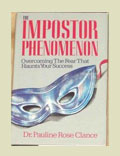
Since the publicaiton of my original Impostor Phenomenon book, The Impostor Phenomenon: Overcoming the Fear that Haunts Your Success, it has been translated into several languages. At this time I do not have copies for purchase; however, there are some available at Amazon.com
Panati, Valentina (February, 2013). Italian Publishing House requested buying rights to translate Dr. Clance's Impostor Phenomenon book in Italian for publication.
Clance, P.R. (2001). The impostor phenomenon: When success makes you feel like a fake. St. Petersburg, Russia: Pyrozchov Publishers (translated in Russian).
Clance, P.R. (1988). Erfolgreiche versager (imposter phenomenon): Das hochstaple phanomen. Munich, Germany: Heyne.
Clance, P.R. (1987). Suksessen baerer maske(imposter phenomenon). Spydeberg, Norway: Tano.
Clance, P.R. (1986). Le complex d'imposture (imposter phenomenon). Orne, France: Flammarion. The Impostor Phenomenon book has also been published in Japan.
Clance, P.R. (1985). The impostor phenomenon: When success makes you feel like a fake. New York: Bantam Books (softback).
Clance, P. R. (1985). The impostor phenomenon: Overcoming the fear that haunts your success. Atlanta: Peachtree Publishers (hardback).
IMPOSTOR PHENOMENON ARTICLES
The following are my article publications/book chapters on the Impostor Phenomenon:
Clance, P.R., and Imes, S.A. (1978). The impostor phenomenon in high achieving women: Dynamics and Therapeutic interventions. Psychotherapy: Theory Research and Practice, 15, 241-247.
Imes, S.A., and Clance, P.R. (1981). Treatment of the impostor phenomenon in high achieving women. In C. Brody (Ed.), Women Working With Women, pp. 75-88. New York: Snapfinger Publishing Co. Matthews, G., and Clance, P.R. (1985). Treatment of the impostor phenomenon in psychotherapy clients. Psychotherapy in Private Practice, 3(1), 71-81.
Clance, P.R. and O'Toole, M.A. (1987). Impostor phenomenon: An internal barrier to empowerment and Achievement. Women and Therapy, 6, 51-64.
Clance, P. R. and O'Toole, M. A. (1988). The imposter phenomenon: An internal barrier to empowerment and achievement. In E. D. Rothblum and E. Cole (Eds.), Treating Women's Fear of Failure. New York: Haworth Press.
Clance, P.R., and O'Toole, M. (1989). Impostor phenomenon. In H. Tierneyt (Ed.), Women's Studies Encyclopedia, Vol. 1. New York: Greenwood Press. Holmes, S.W., Kertay, L., Adamson, L.B., Holland, C.L., and Clance, P.R. (1993). Measuring the impostor phenomenon: A comparison of Clance's IP Scale and Harvey's I-P Scale. Journal of Personality Assessment, 60(1), 48-59.
Langford, J., and Clance, P. R. (1993). The impostor phenomenon: Recent research findings regarding dynamics, personality and family patterns and their implications for treatment. Psychotherapy, 30(3), 495-501.
Clance, P.R., Dingman, D., Reviere, S.L., and Stober, D. R. (1995). Impostor Phenomenon in an interpersonal/social context: origins and treatment. Women and Therapy, 16(4), 79-96.
Chrisman, S. M., Pieper, W. A., Clance, P. R., Holland, C. L., and Glickauf-Hughes, C. (1995). Validation of The Clance Impostor Phenomenon Scale. Journal of Personality Assessment, 65(3), 456-467.











Web Solutions, www.SybilOnDesign.com, sybil.israelian@gmail.com




